Thursday, August 16, 2012

AS results

Hi,

I've just collected my AS results. I was hoping for all A's.

I took my ICT a year early so have actually picked up my final result for A2 ICT. I got an A*! Obviously very pleased with that.

In Physics and Biology I got A's. An A is the highest possible in AS level, so am again thrilled with these results.

As you may know, I am hoping to take Chemistry at university and so Chemistry is really the most important result. I got a B. I'm disappointed with this as I thought the exam went ok, but I got a c in the exam, luckily I got an a in January, so it is possible to still get an A overall. I will be resitting the exam and ordering to get my paper sent to me so I can see where I went wrong.

Overall they are fantastic results, but it is marred somewhat by. The subject I'm wanting to take in university being the one I did worst in. I still want to do Chemsitry, and will just have to put more effort into it. Perhaps I was complacent after the success in my January exams and didn't put the needed effort into the exam. Needless to say I will be revising a lot more now. In fact I plan to start revision for the resit  during the holidays.

It might be that I need a new revision technique. Does anyone have any?

Thanks,
Matt B

Tuesday, August 14, 2012

Ted

Ted poster1
This film is rude, disgusting, vile, inappropriate, taboo.......
And that is why I loved it so much!

Essentially the film is about a teddy bear, Teddy, that can talk after a child made a Christmas wish. A child's Christmas wish is the powerful thing, but as the narrator correctly points out it isn't:
Now if there's one thing you can be sure of, it's that nothing is more powerful than a young boy's wish. Except an Apache helicopter. An Apache helicopter has machine guns AND missiles. It is an unbelievably impressive complement of weaponry, an absolute death machine.
The bear grows up, with its owner, into an offensive bear (now called Ted).

The two of them take drugs together, drink far too much and take the piss out of each other pretty much all day. But, they love each other which is one of the less comedic themes that runs throughout the film. The film is obviously a comedy, but in many ways could be construed as a weird romance involving 3 characters.

Ted loves John. John loves Ted back. But, John loves Lori. Lori doesn't love Ted (as much as John does anyway). She wants Ted out so John can finally grow up. He doesn't want Ted to go. Ted doesn't want to go. I mean it is a story as old as time itself.

Friday, August 10, 2012

Pay for Privacy

I read an article today about how a man's entire digital life was ruined in the space of an hour. He was hacked by some so called 'ethical' hackers who were making a point about different companies lax security procedures, namely apple and amazon. After reading it I went to my most important and connected online accounts and went direct to their security pages. There I was looking for security and privacy options that I could turn on.

First I enabled two-step verification for my email account. This means when I log on to a computer I have not used before I must type in a 6 digit code that is sent to my mobile before I can log in. The same procedure is also used when I forget my password. Extra hassle, yes. Peace of mind, more so.

However, certain companies only offered the best privacy and security settings for premium members.

Why should I have to pay for security? Surely it is in the companies' best interest to offer me their most secure of security features and their most powerful privacy tools for free? The paid extras should be things like more space, or the ability to upload lager files. I should not have to pay to stop hackers from accessing my files.

On Box.com, for example, if I wish to have encrypted storage I need to pay for an enterprise account. Why? Why should I have to pay for my files which I upload to their servers to be encrypted? Why should I have to pay for them to be encrypted if I transfer them to another person?

I just received an email from Prezi - a service I haven't used in years. It was advertising their premium account. Their biggest feature was the ability to make Prezis private. I should have that feature for free. I should not have to pay for it.

Sure, companies have more at stake if you are paying for their services, so perhaps they feel the security of paying customers is more important. Bull-shit!

I wouldn't expect NatWest to say to me, "Good afternoon, sir. Did you know for only £20 a month NatWest won't put a poster up with your bank account details? For an extra £5 a week you also have the option of having a PIN. Even better if you pay us just £2 a day we will let you have a strong password on your online banking account."

It just wouldn't happen. But, a service I use to store backups of my school work and writing wants me to pay for security. I know that a hacker isn't going to personally target my school work, but that doesn't mean I won't be collateral damage to one of these 'ethical' hackers. What if I needed the backup of my work, but Box was targeted by LulzSec (I think they have disbanded, though) or Anonymous? What if my account was chosen at random to be the the account they decided to showcase the security holes with? Am I expected to sit back and think, 'if only I'd paid premium prices'?

It is utter stupidity that companies would even consider charging for security. In a world that is ever more online it is damn time that company execs got their heads out of the clouds and into cloud security ... for free.

Wednesday, August 1, 2012

Commitment

Writing is hard.

It just is.

That is why commitment is so important. If you start something, I think it is important that you try your hardest to finish it. I have been writing as a hobby for 6 years. In that time I have written some good stuff … and some not so good stuff. Despite the bad stuff, I pride myself on one particular statistic:  I have only ever stopped writing two pieces before they were finished.

For me this is important. The satisfaction of completing a piece of writing is one of the greatest feelings one can feel. The knowledge that you have crafted characters, worlds, civilisations, emotion, and more with just words. Since I joined writing.com, I have uploaded all but one of my stories. The reason is I get a thrill from knowing that someone, somewhere, has read those words and been transported to a world of my creation. What more could a writer wish for … apart from publication? However, if you don’t finish you leave yourself with half a world; a character left in endless turmoil; a civilisation, yet to defeat the evil wizard.

The decision to stop writing the two pieces was a tough one to make. The first one I stopped was a Christmas story that would be a sequel to one of my short stories. I stopped because I never really started. The feel was too different from the first story and my ability as a writer was not up to the level it needed to be to do the story justice. I wrote a different Christmas story that year that was, in my opinion, very good.
The second was more recently. I was entering a short story contest, but realised the story I was writing required me to write in early modern English for much of the dialogue. Without extensive support, I would not have been able to write it. Instead, I wrote a different story with a completely different plot and cast.
Both times, I stopped writing because I didn’t have the skills to do the story justice. I also kept copies of the stories I stopped; one day I may restart them with new skills and a fresh mind.

Saturday, June 30, 2012

Top 10 Tips from the Masters


The following tips are from the Writing Classes website  . I have compiled a top 10 of these rules, with my own analysis.

1. Write. (Neil Gaiman)

It goes without saying, if one wishes to be a writer, one must first write. Writing is not easy. Although his second practice starts with ‘put one word after another’, it is important to take note of the full practice:

2. Put one word after another. Find the right word, put it down. (Neil Gaiman)

Anybody can jumble together a collection of words, but it takes true skill to get words that portray the meaning you want. There are 26 letters in the alphabet. Even simpler there are four squiggles that make up all 26 letters: the line, the curve, the dot, and the flick. It is our job as writers to give meaning to these simple squiggles on a page and to give the reader a reason to want to find that meaning.

3. Never open a book with weather. (Elmore Leonard)

Readers don’t care what the weather is like in your story. Of course, there is an exception to the rule: if the story is the weather, you can open with it. I mean, if there is a storm in your world and the story is about the storm, it is OK to start your story with it.

4. Try to leave out the part that readers tend to skip. (Elmore Leonard)

Obvious really. If the reader is going to skip over it, don’t write it in the first place. This goes hand in hand with another of Elmore’s rules: ‘Avoid prologues’. Some readers don’t read the prologue; therefore, you shouldn’t put one in. At least that’s how I view his rule.

5. Never use a verb other than "said" to carry dialogue. (Elmore Leonard)

Sunday, June 10, 2012

Are you sure?

Warning this post contains strong language.
So you're here to read another rant by me. Are you sure? Yes. Ah good. Shall we continue? Are you sure? OK, let's go. There is strong language, do you wish to continue? Yes. Are you sure?

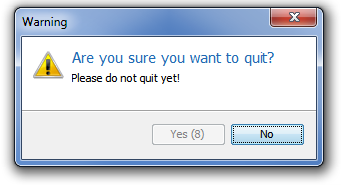
One thing that irks me above all other stupid things that technology does is when it asks me if I'm sure.

For instance, I've played a game on the computer and now I want to get off it. So, I save my game. Then I quit to the menu. Are you sure you want to quit to the menu? Well, yes, I did just click on that button. Then on the menu I click Quit Game. Are you sure you want to quit the game? Yes, yes I do - why else would I have clicked the quit button?

OK, so it is making sure I didn't accidentally click on the button. However, to quit to the menu required me to:

1. Stop playing
2. Navigate my mouse to the menu button
3. Click the menu button
4. Navigate the mouse to the save button
5. Save my game
6. Navigate to the quit to menu button
7. click the quit to menu button

Now, I would say that I'm pretty damn determined that I want to quit to the menu. Otherwise I may not have done step 1. It's not like the game has its buttons really close. They are nicely spread out so that any imbecile could click on the button they wish without missing and hitting the wrong one.

Then once I've quit I am faced with a full screen menu that contains 4 buttons on it. One button in the top right corner is the settings button. It's pretty far from the other buttons. The two in the middle are New Game and Load Game. The exit button is right at the bottom. Far, far away from any other button. So why do you insist on asking if I am really sure I want to do what I'm pretty obviously sure I want to do?

Wednesday, May 23, 2012

Meiosis and Writing

meiosis diagram
Meiosis Diagram
courtesy of sciencegeek.net
As an A-Level Biology student, I strive to understand the world around me. From learning how water gets from the ground to the leaves of a giant Oak Tree to how insects survive without blood, I am fascinated by nature.

One day, whilst learning about how meiosis causes variation I had a brainwave. What if I could cross my love of writing with my knowledge of meiosis? At first, I struggled to think of the connections, but I think I’ve managed to work it out.

I will be using three key ways that meiosis causes variation to think about how we, as writers, can vary our writing. This article will form the final part in my three-part series on being unique in writing.

Please note that I have simplified the biology in this article and missed processes out to make it more approachable for those without a scientific background.

Independent Assortment (of chromosomes on the spindle)

In biological terms, this means that chromosome pairs will align along thread (the spindle). This means that it doesn’t matter where the other pairs go on the thread, each pair will go wherever it pleases.

So, how can writers apply this principle?

It doesn’t matter what Stephen King is writing, or what Tolkien did – you are you. Put your characters in the situations you want to put them in. Sure, the Lord of the Rings is a successful series, but that doesn’t mean you need to copy it.

Be your own writer. You know what you want to write better than anybody else does, and the chances are somebody, somewhere will want to read what you have written. You shouldn’t ignore other writers, but you should remember that the best writing often comes when the author writes their piece in the way they wanted.

There is every chance somebody will suggest a change to the plot and by all means embrace the opportunity to make your piece more appealing, but if it goes against everything your piece stands for … well, don’t do it.

Crossing-over (of alleles)

Monday, May 7, 2012

Ghost in the Wires

Hi,

I recently finished Ghost in the Wires by Kevin Mitnick.

Ghost in the Wires Cover Image
Ghost in the Wires cover

The book is an autobiographical account of Mitnick's 'adventures as the world's most wanted hacker'. He starts out by explaining his love for magic and deception as a young child, including a description of how he managed to get free bus rides around town.

Mitnick then describes his rise to notoriety in a thrilling, and suspenseful, tone that leads to numerous close shaves and hair-raising near encounters with the FBI.

Throughout the book Mitnick (and co-author, William Simon) uses an engaging writing style that never fails to keep you on the edge of your seat. I'm not normally a reader of any form of biography, but this is most definitely the exception. I mean, it has a helicopter chase in it. How many autobiographies have helicopter chases in?

I got this book for Christmas and started reading it, but a load of stuff happened that prevented me from being able to read it and it found its way to the bottom of the pile. After I found it again, I managed to finish reading it in less than 2 weeks (and I'm not the fastest reader).

The book contains details of many of the people he met in his hacking career (and all of their aliases) and how he worked with them, against them or how he was betrayed by them. Along with these people, he also showed how a strong family was vital for him. His mum and gram proved to be his backbone - his constant throughout his adventures.

As a computer geek myself, I thoroughly enjoyed the sections where the technical aspects of his exploits were explained and some of the codes shown. This really added a sense of wonder to his abilities and made the section about Novell NetWare even more enjoyable. This section was of extra interest as it is the system my college uses.

The book starts drawing to an end with his arrest and the Free Kevin protests that kept him going whilst inside. The end isn't quite as engaging as the middle, but that is to be expected with any book. The final chapter briefly details his change from the world's most wanted hacker to the world's best hacker with his own (legal) security firm, Mitnick Security.

Overall, it is the best non-fiction book I have ever read, and pretty close to my favourite book of all time.

Below is an interview (50 minutes) with Kevin Mitnick from Authors@Google:

Saturday, May 5, 2012

Microsoft

Warning this post contains some strong language.


One thing that really irks me is when people say things like 'that's Windows for you.' If anyone says that to you they are one of the following:

1. A liar
2. A mac user
3. A Linux/ubuntu user
4. Really bad with computers
5. All/Combination of the above

I use Windows 7, I used to use Vista and still use XP at school. The majority of issues I encounter are my own (or the school's) fault. For example I had a blue-screen last year. Now, I look online for solutions to this problem and encounter post after post of window-hating, mac-loving idiots.

Every single one of them said that I should by a Mac, or windows is for losers. Piss off!

In the end I realised that sometimes shit happens. And sometimes it is me who did the shit (could be worded better). I had opened too many application and was doing too much at a time. I was downloading a large file of the internet, watching a HD video on YouTube, rendering a film and burning it to DVD and installing 2 applications. I had iTunes playing music and Tweet deck overloaded with tweets about the riots. It was not Microsoft's sole fault that my computer blue-screened. It was my fault for not considering what my machine could handle.

Another issue people have is with networking Windows machines. I can do it with little hassle. Why? Because I know how and took the time to learn. Sometimes the moment something goes wrong they look for someone to blame rather than a solution. Why? Because they're idiots. Don't try and connect an XP machine to a windows 7 machine with a home-group and then blame Microsoft for not allowing compatibility.

If every new feature had to be compatible with every other old feature nothing new would ever be made. Stop being a dick and accept you've got an out-dated OS and if you want to use modern features you need to upgrade.

Then there are those people who claim Apple makes the best hardware, the best software and sun shines out of its bloody backside. They are wrong. Case in point: iTunes. When I run iTunes, almost 60% of my processing power is used and I am limited to browsing the web or typing stuff. I claimed at the start of this rant that people shouldn't blame companies for every fault, but I am aware that sometimes the blame does lie in shoddy coding. Apple prioritised Apple customers (as you would expect, nothing wrong there) and allowed Windows users to suffer. I don't blame them, they are right with there priorities, but they aren't Gods. They don't get everything right.

Sunday, April 22, 2012

Embrace the Cliché

Last month I spoke about being unique in your writing and how to not be a copycat. In the second part of this series of articles, I am going to cover the embracement of clichés.

The other week, I was looking through my twitter-feed and came across a tweet from Amanda Wilcox that proves I am not alone in embracing clichés:

“The art of story writing seems to be simply re-writing clichés in your own words.”

I don’t know if I can attribute it directly to Amanda, or if someone else said it first, but story writing certainly seems that way.

I touched upon genre property last month, but not all genre property is cliché. Magical schools are not yet cliché and still have much uncovered ground. However, vampires are probably now cliché, what with Dracula, Twilight, The Vampire Diaries, and The Secret Circle to name but a few.

That isn’t to say that vampire stories should be avoided. If approached sensibly and with the right mind set any cliché can be turned into something new and exciting.

Before we go any further, perhaps an exploration into the definition of a cliché is needed. According to the Collins dictionary it is:
“An idea or phrase which is no longer effective because it has been used so much.”
This definition states that it can’t be used effectively any more. However, that doesn’t explain why some clichés are effective even after they have become ‘overused’. Perhaps I am being too broad with my own definition of:
“Something that has been used so much that it becomes predictable.”

Even with my definition, you probably would think it best to avoid any cliché where possible. Nevertheless, I am a firm believer that we shouldn’t waste clichés and should whole-heartedly embrace them with open arms. After all if you don’t try, you’ll never know, and knowledge is power. Remember that with great power comes great responsibility and that to use clichés is a privilege, not a right.

OK, so I went a little overboard with my clichés there, maybe to serve as an example of what not to do with them.

LinkWithin

Related Posts Plugin for WordPress, Blogger...
AbeBooks.com – Textbooks